When business leaders evaluate tools to grow revenue and streamline customer journeys, they often hear two terms used interchangeably: CRM and marketing automation. But they are not the same thing.
Understanding the key differences between CRM and marketing automation helps you choose the right system for your business, avoid costly mistakes, and build a strategy that scales.
In this guide, we’ll break down:
- What CRM systems are
- What marketing automation platforms are
- How they differ
- How they work together
- Which one your business needs (and when)
A CRM (Customer Relationship Management) system is a centralized database that stores all information about your customers and prospects.
Key Functions of a CRM
A CRM helps you:
- Track interactions with leads and customers
- Store contact info and communication history
- Manage sales pipelines and deal stages
- Record tasks and follow-ups
- Analyze revenue and forecast sales
- Share customer data across teams
Think of a CRM as the source of truth for your customer data.
CRMs focus on relationship management — keeping track of the people who matter to your business.
Examples of CRM activities:
- Logging phone calls and meetings
- Tracking deal value and close date
- Seeing all touch points a sales rep has with a lead
- Assigning tasks and reminders to sales reps
Marketing automation uses software and data to automatically execute marketing tasks, nurture leads, and engage customers based on rules, behavior, and triggers.
It helps you:
- Automate email campaigns
- Personalize messages at scale
- Trigger actions based on customer behavior
- Score leads based on engagement
- Orchestrate multi-channel journeys (email, SMS, web)
- Track campaign performance and conversions
Marketing automation focuses on driving action and engagement — while CRM focuses on managing relationships and sales outcomes.
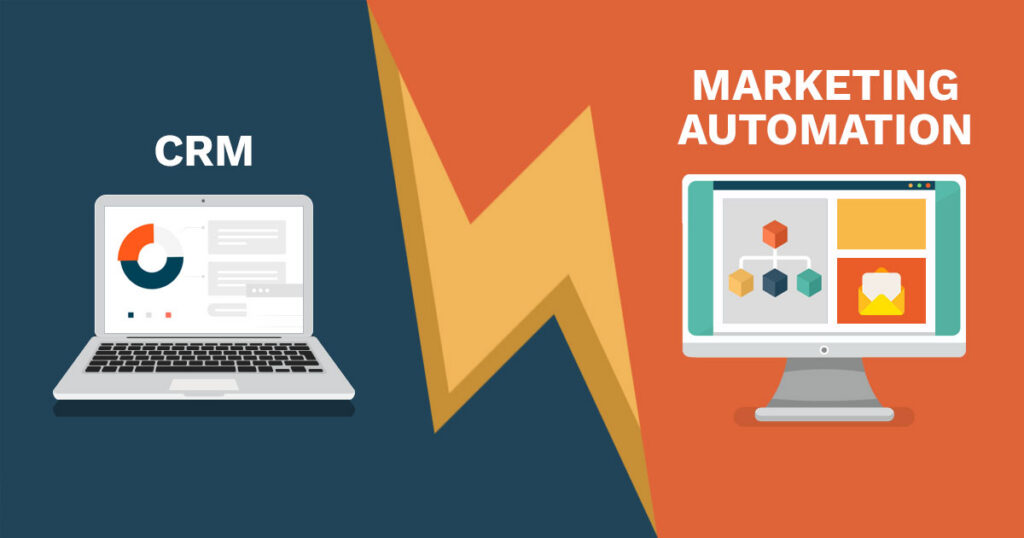
CRM vs Marketing Automation: Side-by-Side Comparison
Feature | CRM | Marketing Automation |
Primary purpose | Manage customer relationships & sales pipeline | Automate marketing tasks & nurture leads |
Main users | Sales teams | Marketing teams |
Key focus | Customer records & deals | Campaigns, workflows, triggers |
Data stored | Contact details, interactions, deals | Behavioral data, engagement tracking |
Automation | Limited (task reminders) | Extensive multi-step automation |
Personalization | CRM data in sales context | Personalized messaging at scale |
Reporting | Sales performance & revenue | Campaign performance & funnel analytics |
Although they serve different functions, CRM and marketing automation systems are better together.
Here’s how:
1. Unified Customer Data
Marketing automation systems feed activity data into the CRM — like email opens, webpage visits, or downloaded content — giving sales deeper context.
2. Lead Scoring & Qualification
Marketing automation identifies high-intent leads and automatically passes them to the CRM when they are ready for sales engagement.
3. Aligned Teams
Sales sees the same data marketing does, reducing guesswork and improving conversions.
4. Automated Handoffs
- Marketing automation nurtures leads
- CRM accepts qualified leads from marketing
- Sales follows up faster and more accurately
This creates a seamless revenue process.
A CRM is essential when:
- You want to track leads and customers in one place
- You need visibility into your sales pipeline
- Your team handles deals, quotes, and closings
- You want accurate sales forecasts
- You need one source of truth for customer data
Without a CRM, you risk data silos, lost leads, and inconsistent communication.
Marketing automation is essential when:
- You want to nurture leads without manual follow-ups
- You have recurring campaigns, sequences, or funnels
- You want to personalize messaging at scale
- You need to automate cross-channel campaigns
- You want behavioral triggers (e.g., abandoned cart, page visits)
If your marketing strategy relies on timely, relevant engagement — automation helps you do it without burning resources.
Not always — but most fast-growing companies do.
Small businesses just getting started:
- Start with a CRM to centralize contacts and manage relationships.
- Marketing automation can come later.
Marketing-heavy companies (eCommerce, SaaS):
- Marketing automation is often as important as the CRM.
Scaling businesses:
- You need both to generate leads, nurture them, and close deals efficiently.
Example 1: B2B SaaS Startup
Before automation:
- Marketing sends emails manually
- Sales tracks data in spreadsheets
- Leads get dropped
After CRM + automation:
- Automated nurture sequences
- Sales sees engagement history
- Fast follow-ups increase conversions
Example 2: ECommerce Store
Without automation:
- Cart abandons go unnoticed
- Customers receive generic emails
With automation + CRM:
- Abandoned cart reminders sent automatically
- Personalized offers based on past purchases
- CRM tracks lifetime customer value
When choosing tools, ask:
- Does the marketing automation system integrate with my CRM?
- Are contact records synced bi-directionally?
- Does lead activity show up in CRM timelines?
- Can sales trigger actions based on CRM data?
Many modern platforms offer native integrations, but some may require middleware or API configuration. Integration is the bridge that unlocks real revenue growth.
“CRM and automation are the same thing.”
No — CRM manages customer data. Automation executes engagement.
“I only need email automation.”
Email is only one channel — the best automation includes multi-channel engagement and AI personalization.
“CRM can fully replace marketing automation.”
Most CRMs alone don’t have the behavioral triggers, workflows, or campaign capabilities marketing automation systems provide.
For CRM:
- Ease of use
- Sales pipeline features
- Contact & activity tracking
- Reporting and forecasting
- Integration ecosystem
For Marketing Automation:
- Workflow builder
- Segmentation and personalization
- Multi-channel campaigns
- Behavioral triggers
- AI-assisted features
CRM and marketing automation serve different purposes — but together, they form a powerful engine for growth.
- CRM helps you manage relationships
- Marketing automation helps you scale engagement
Remember: Growth isn’t just about tools — it’s about the systems and strategy behind them.
If you’re on CRM-Forge.com, consider offering:
- CRM readiness audits
- Automation strategy assessments
- Implementation and integration services
- Training and support